Infrastructure Built for Yesterday's Weather
26 years of NWS data show a pattern shift that every North East Texas Lake community should understand.

I’ve lived on Cedar Creek Lake long enough to develop a reliable internal weather detector, and it works like this: Hot → Windy → Rainy, repeat. No Wi-Fi or app required. It even comes with its own warning system: when you hear thunder at 2 AM, your immediate thoughts are, “Did I leave the truck windows down?”
Lately, though, it feels like the storms have been changing—and it’s been hard to put my finger on exactly how. Are storms getting bigger? More frequent? My curiosity got the best of me, so I pulled 26 years of NWS rainfall data for DFW and started looking for patterns. It turns out it’s more than a curiosity; it’s a cause for community concern and action.
The Annual Totals Look Normal, But They Are Not
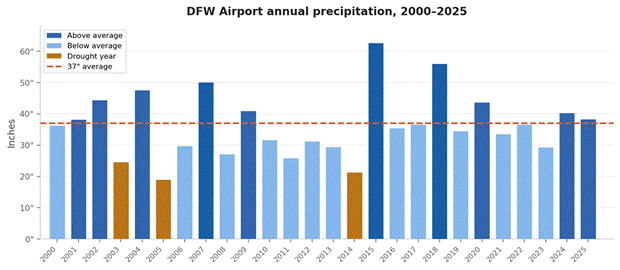
The long-term average for DFW holds at roughly 37 inches, and most years land reasonably close. However, annual totals can be completely deceiving. It’s the same as looking at your beginning and ending checking account balance for the month—the numbers might look fine, but they tell you nothing about whether you got paid in steady deposits or had one massive windfall followed by three weeks of overdrafts.
Annual rainfall at DFW Airport from 2000 to 2025. The dashed red line marks the 37″ long-term average. Dark blue bars exceeded the average; light blue fell below it; amber marks drought years under 25 inches.
Source: National Weather Service, DFW Airport station data
When your drainage infrastructure was engineered for steady deposits, and the water starts arriving in lump sums, you have a growing problem.
The “Haymaker” Months
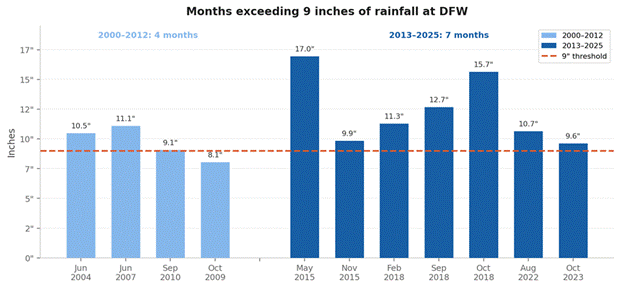
This is where the data gets interesting. I pulled every month from 2000 through 2025 where DFW recorded more than 9 inches of rainfall. Nine inches in a single month is roughly a quarter of the annual average hitting the ground in 30 days—the kind of volume that tests every culvert, ditch, and outflow in its path.
Every month from 2000 to 2025 where DFW recorded 9 or more inches of rainfall. Light blue bars are from the first 13 years (4 events); dark blue bars are from the most recent 13 years (7 events). The dashed red line marks the 9″ threshold.
Source: National Weather Service, DFW Airport station data
The pattern is striking. In the first 13 years (2000–2012), it happened 4 times. In the most recent 13 years (2013–2025), it happened 7 times—nearly double the frequency. Additionally, the peaks got dramatically more intense: May 2015 delivered almost 17 inches in a single month, and October 2018 dropped over 15 inches.
What Does the Science Say?
John Nielsen-Gammon, the Texas State Climatologist, found in his 2024 report that extreme one-day precipitation across the state has increased 5% to 15% since the late 20th century. He projects another 10% increase in extreme rainfall intensity by 2036.
The physics are straightforward: for every degree Fahrenheit the average temperature rises, the atmosphere holds about 4% more moisture. When that moisture comes down, it arrives all at once, in the kind of storm that turns a backyard into a detention pond and a culvert into a fire hose.
The Projection: 30% to 50% more urban flooding if current trends continue.
The Infrastructure Reality: NOAA’s updated Atlas 14 for Texas found that rainfall amounts previously classified as 100-year events in some areas are now reclassified as 25-year events. The storm your drainage was designed to handle once a century is now showing up four times as often.
What This Means for the DFW Reservoir System
I’m the founder of a drone-based aerial mapping company with a personal stake in this—our Star Harbor property has flooded twice, resulting in over $250K in damages.
The communities around Cedar Creek Lake—Gun Barrel City, Mabank, Tool, Star Harbor, Malakoff, and others—were built with drainage infrastructure designed for a climate that no longer exists. The culverts, ditches, and outflows were sized for the rainfall patterns of the 1970s, ’80s, and ’90s, when 15-inch months were unthinkable. We’re not in that world anymore.
The Good News (Yes, There’s Good News)
Texas has money set aside for exactly this problem. The Texas Water Development Board’s Flood Infrastructure Fund (FIF) currently has close to $1 billion available for drainage and flood mitigation projects.
The challenge for smaller communities is that applying for state funding requires data. You need to know where your drainage choke points are before you can apply for the dollars to fix them. That’s the gap I’m working to close. Modern GPS drone-based mapping can produce centimeter-calibrated imagery of an entire drainage network in days, not months. It gives communities the data foundation they need to pursue funding before the next haymaker arrives.
THE TAKEAWAY
North Texas isn’t getting more rain; it’s getting more rain events that matter. The annual averages mask a fundamental shift—fewer moderate storms, more high-intensity deluges. The storms aren’t waiting, and the data says they’re getting worse. The time to map what you’ve got—and figure out what you need—is while the ground is still dry.
Mark Shedd is the founder of BFD-Mapping LLC, a drone-based aerial mapping company in Malakoff, Texas, specializing in floodplain drainage assessment for municipalities and water districts. He is FAA Part 107 certified and can be reached at mark@bfd-mapping.com.
BFD-Mapping LLC provides only aerial mapping and assessment services. We are not a licensed surveying firm. All mapping products are intended for planning and assessment purposes and do not constitute a land survey under Texas Board of Professional Engineers and Land Surveyors (TBPELS) regulations.